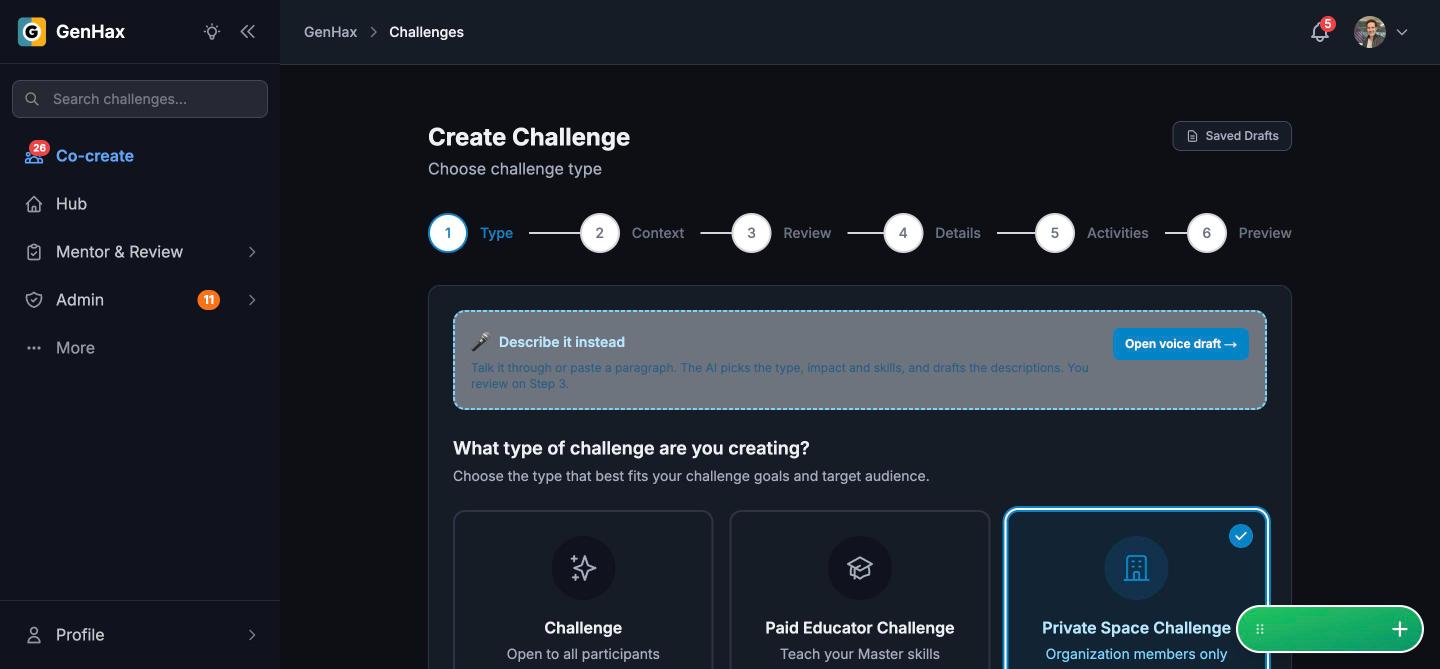
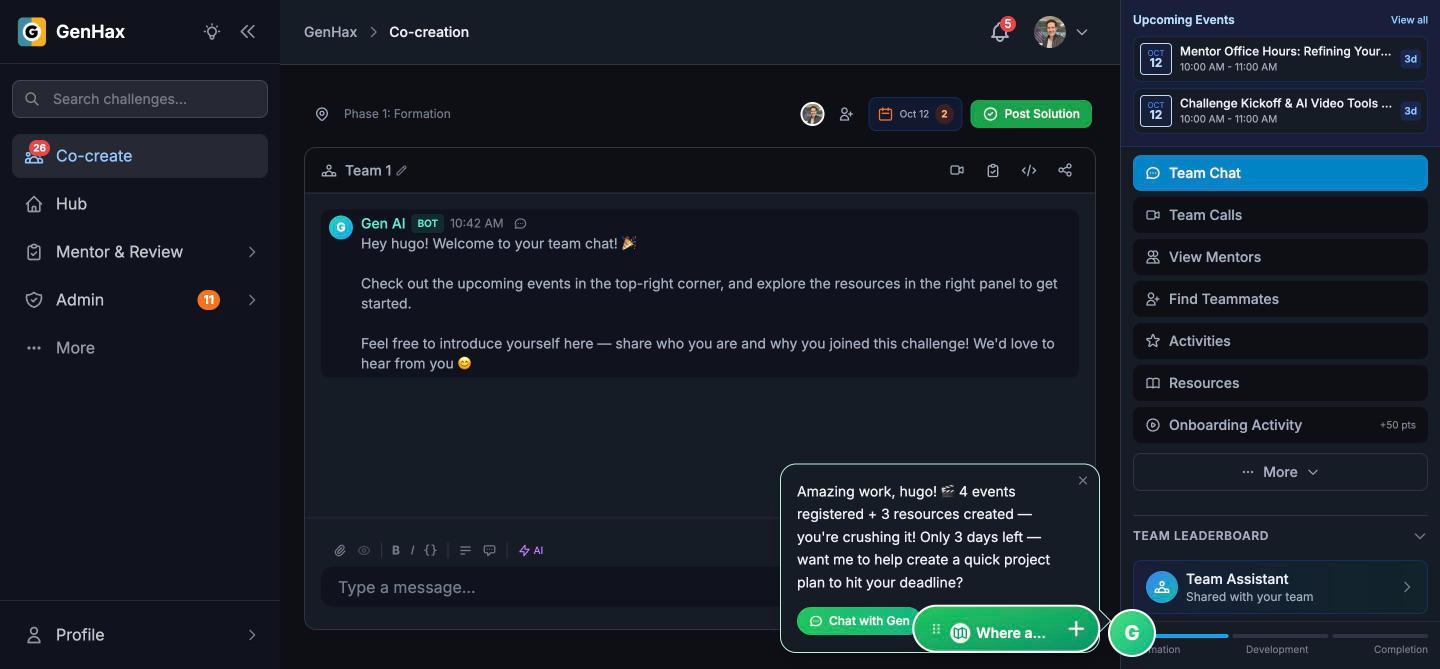
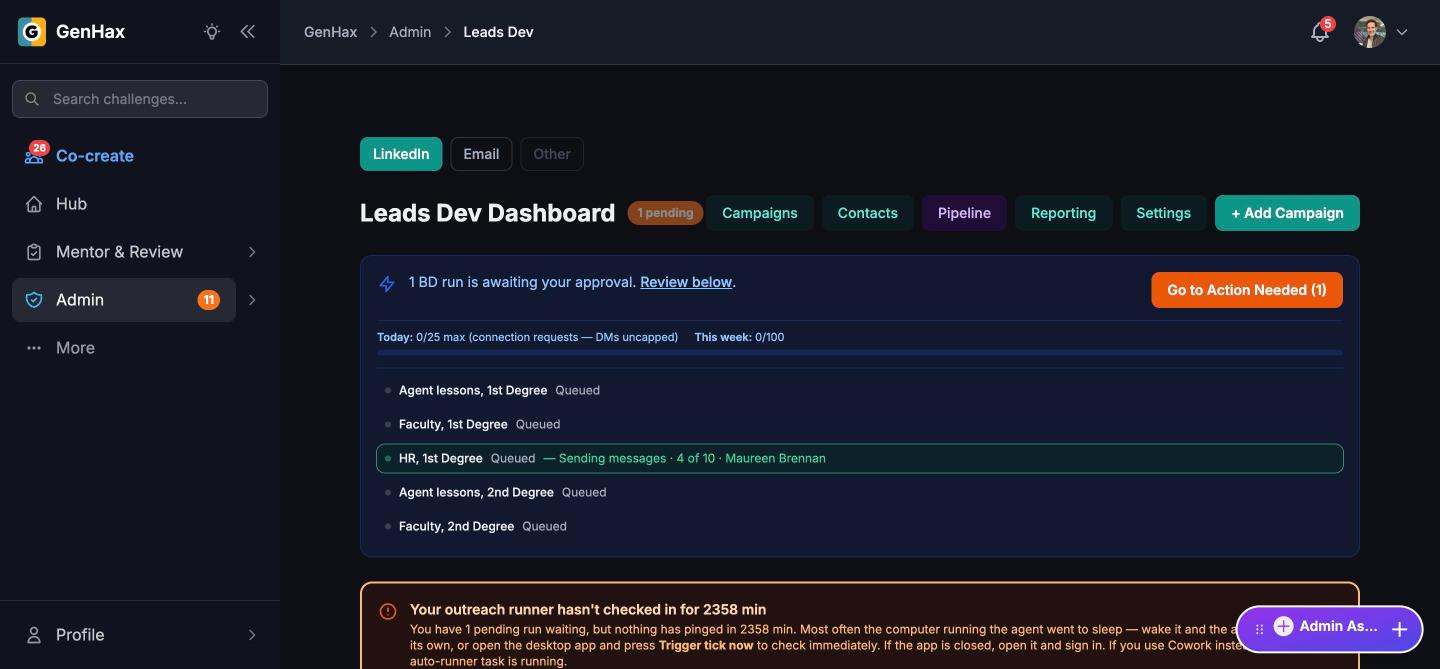
I don't hand off strategy and walk away — I build the thing. GenHax is designed, coded, and operated by me end to end, across its web platform, desktop automation agent, and Chrome extension.
Inside the app
Challenge creation wizard
Founder · Product · Engineering
GenHax
An AI-powered co-creation and experiential learning platform: teams, students, and hackathon veterans solve real-world challenges through AI-guided workflows, with work evaluated into verified skill badges — not self-reported claims. Deployed across universities and organizations, including NSF-backed projects, to upskill workforces and ship real software. GenHax also runs AppHax, a dedicated app-development arm that builds mobile and web apps for nonprofits, startups, and enterprises — from a one-week prototype to fully built, maintained applications.
Web platform (Next.js)
Desktop automation agent
Chrome extension
Postgres / Supabase
NSF-funded, 3-year program
Built in 2 months, 4 months of beta
Powers KGC Build & KGC Learn
AppHax client build
KGC · Knowledge Graph Conference
Positioning and the platform behind KGC's two brands — KGC Build, their hackathon line, and KGC Learn, their lessons line. The hackathon platform (branded KnowHax) was designed and shipped in 2 months, NSF-funded, with 10 participant-facing features and 7 admin features: onboarding, chat, calendar, activities, badges, leaderboards, and real-time team scoring.
"Hugo and the GenHax team exceeded expectations for our KnowHax hackathon and received gleaming praise from the NSF who were the main sponsor." — Thomas Deely, KGC co-founder
Built through AppHax
Client: Parity Productions
Shipped to production
AppHax client build
Parity Database
A production app built and delivered through AppHax, GenHax's app-development service — taken from prototype to a live, maintained application, shipped as both a web app and a mobile app.
Web app
Mobile app
Basic: 1-week prototype or 2-month no-code build
Advanced: competitive bid, vetted freelancers
$1,000–$100,000 prize pools
App development service
AppHax
GenHax's build service for founders and organizations. Basic: a one-week prototype (∼$1,000), or a fully built no-code app over two months ($2,000/mo). Advanced: a competitive build challenge where vetted freelancers bid for the work, with prize pools from $1,000 to $100,000 for premium design and development. Optional maintenance training either way.
AppHax client build · MVP
Micasa
An events platform for hosts to run intimate private events and split ticket revenue with the collaborators — musicians, chefs, artists — who make them happen, with payouts handled automatically after the event. We built their MVP.
Divorce Cost & Impact Calculator
Live
GTM & Content Consulting
Rodriguez Law & Mediation
Positioning, content, and local-SEO engagement for a Manhattan divorce mediation practice: Google Business Profile strategy, blog and neighborhood-expansion content, a review-generation playbook, and a full Spanish-language track for the firm's bilingual client base. The interactive piece above — a Divorce Cost & Impact Calculator comparing mediation to litigation — is a lead-generation tool I designed and built myself, live on the firm's site.
hugogenhax.github.io/irene-sudac-site
Live
Positioning & Site Build
Irene Sudac · Enericadus
Positioning and website for a manufacturing & operational-finance consulting practice serving global manufacturers. Navigation is organized by the problems buyers actually search for — margin, working capital, ERP and order-to-cash, captive finance, footprint — instead of generic service categories, built around how a deal really gets forwarded internally from a plant controller to a VP of FP&A.
hugogenhax.github.io/wedding-site-KH
Live
Personal build
Katie & Hugo
A wedding site built end to end for our own event: a custom RSVP flow backed by Google Sheets, a dynamic photo gallery, and a guest-details page encrypted client-side (AES-GCM, password-derived key) so the content behind it stays private to invited guests — what's live above is the real gate, not a mockup.
app.genhax.com/sencial
Live
GenHax client build
Sencial Memory
An AI app for Meta Ray-Ban smart glasses, built for Sencial Inc. Their S4D engine isolates individual speakers from ambient noise in under 10ms, running on-device; GenHax built the product around it — real-time voice identity matching against a personal contact graph, for people navigating social situations with Alzheimer's, PTSD, or hearing loss. The scenarios section above shows eight real use cases.
app.genhax.com/nsf-gaps-to-graphs
Live
NSF · Proto-OKN
Gaps to Graphs
A tool built for the U.S. National Science Foundation's Proto-OKN program: researchers describe a policy question in plain language, and it generates a SPARQL query against FRINK's knowledge graphs, scored across five dimensions — policy urgency, economic impact, population scope, cross-KG value, and actionability — with an AI chat to refine the query and regenerate it on demand.